
India and China have held their first diplomatic talks since withdrawing troops from two face-off points in eastern Ladakh, reflecting on the lessons learned from the border row to prevent future incidents. The two sides agreed to maintain peace and tranquillity in border areas, prepare for the next meeting of Special Representatives on the boundary question, and highlighted the importance of regular exchanges and contacts at diplomatic and military levels. The talks come after the completion of the disengagement process from the last two friction points, following an agreement finalized in October 2022.
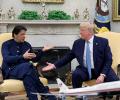
The White House readout of the call was issued after the meeting concluded at the UN headquarters in New York.
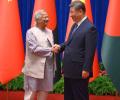
'It was the hostility of the Yunus regime that made India careful and wary of dealing with them.' 'They gradually backed off and lowered the noise, but the damage was done.' 'Their true colours had been exposed.'
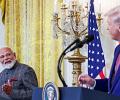
Prime Minister Narendra Modi and US President Donald Trump have vowed to move forward with plans to work together to build US-designed nuclear reactors in India. The decision was made during their meeting at the White House, where they also agreed to significantly expand energy cooperation. The move comes after India announced plans to amend its nuclear liability law and the Atomic Energy Act, which had previously been obstacles to the implementation of the US-India civil nuclear deal.
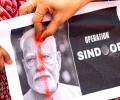
World leaders, including the UN Secretary-General and US President Donald Trump, have urged India and Pakistan to exercise restraint and seek peaceful solutions to the ongoing tensions. The calls for calm come after India conducted airstrikes in Pakistan-occupied Kashmir in response to a recent terrorist attack. Leaders from the US, Russia, UK, China, UAE, Qatar, and Japan have expressed concern over the escalating situation and emphasized the need for dialogue and de-escalation.

The PM emphasised that he has himself met leaders of both Russia and Ukraine and also pointed to his 'this is not an era of war' remark that he made in the presence of Russian President Putin.

Alamgir said that even after the fall of the Hasina government following a people's uprising, the 'Indian establishment is yet to reach out to BNP, even though China, the US, the UK, and Pakistan have already done so.'
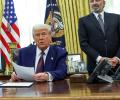
An hour before his bilateral meeting with Prime Minister Narendra Modi, Trump again commented on India's tariff structure, saying 'they have the highest tariffs' and 'it is a hard place to do business'.
The Indian government does not track the number of undocumented Indian immigrants residing in the US. Minister of State for External Affairs Kirti Vardhan Singh, in a written response to a query in the Rajya Sabha, said these immigrants have "legally exited India" but have either overstayed their visa validity, or have entered the US illegally or without valid documents. The response comes at a time when Prime Minister Narendra Modi is on a two-day visit to the US, during which he will hold a bilateral meeting with President Trump. The two leaders are likely to discuss India-US cooperation in sectors like trade, investment, energy, defense, technology and immigration.

China does not have to give up what it took in 2020, it will never give up its claim to Arunachal Pradesh, Ladakh and other areas, and it has all the time now to plan its next surprise, points out Lieutenant General Prakash Katoch (retd).

China on Wednesday said the Chinese and Indian militaries are implementing the resolutions concerning the disengagement in eastern Ladakh along the Line of Actual Control (LAC) in an 'orderly' manner.
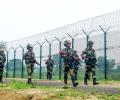
Bangladesh has summoned the Indian High Commissioner in Dhaka over border tensions, accusing India of violating a bilateral agreement by constructing fences at five locations along the Indo-Bangla border. The development comes after Bangladesh officials alleged that India had halted construction of barbed wire fencing due to strong opposition from the Border Guard Bangladesh and local residents.
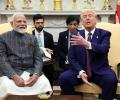
'Trump administration wanted a positive tone at this summit, but there was still some anxiety that there could be some awkward moments -- and there were not.'
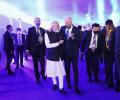
Prime Minister Narendra Modi will visit the Indonesian city of Bali from November 14 to 16 to attend the G-20 summit, the ministry of external affairs announced on Thursday.

The ties between India and Canada came under severe strain following Canadian Prime Minister Justin Trudeau's allegations of a "potential" involvement of Indian agents in the killing of Khalistani separatist Hardeep Singh Nijjar in June.
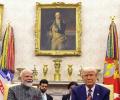
'Modi's intention was to create goodwill that will allow India to be seen by Trump as more than just a bad tariff problem.' 'He succeeded brilliantly on that count but none of these wins are unfortunately permanent.' 'Modi will have to do this again and again if Trump's grievances are to be durably assuaged.'
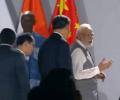
Prime Minister Narendra Modi conveyed to Chinese President Xi Jinping India's concerns on the "unresolved" issues along Line of Actual Control (LAC) in eastern Ladakh during a conversation on the sidelines of the BRICS summit, Foreign Secretary Vinay Mohan Kwatra said on Thursday.

Spin great Ravichandran Ashwin says New Zealand, despite the absence of the long-serving pace duo of Trent Boult and Tim Southee, who have quit playing the 50-over format, will pose a challenge to India.
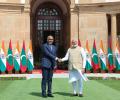
India on Monday asserted that its friendly ties with the Maldives will continue as Prime Minister Narendra Modi and President Mohamed Muizzu unveiled a blueprint for comprehensive economic and maritime cooperation, signalling a reset of the relationship that had hit a rough patch last year due to anti-New Delhi rhetoric.
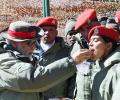
Replying to a question on the Kashmir issue raised by a Pakistani journalist, Chinese foreign ministry spokesperson Mao Ning during a media briefing in Beijing said that China's position on the issue of Kashmir has been "consistent and clear".
'Both international cooperation and self-reliance will now acquire new purpose.'

Prime Minister Modi held separate talks with world leaders including his Nepalese counterpart K P Sharma Oli, and Palestinian President Mahmoud Abbas, discussing various facets of bilateral ties and reaffirmed India's support for the Palestinian people.

All entities operating in India must fully comply with relevant laws, External Affairs Minister S Jaishankar Wednesday told his British counterpart James Cleverly, who raised the BBC tax surveys issue during a meeting with him.

'Fears in Washington began to intensify when it was realised that subsequent Pakistani and Indian attacks on major military facilities -- which were significant in terms of geographic scope and intensity -- could rapidly take both sides to where neither actually wanted to go.' 'The US objective was to stop the fighting as soon as possible. Everything else was secondary.'

Prime Minister Narendra Modi has held talks with Ukrainian President Volodymyr Zelenskyy and reiterated India's commitment for an early resolution of the conflict in Ukraine and the restoration of peace and stability in the region.

China on Tuesday confirmed that it has reached an agreement with India to end the standoff between the two armies in eastern Ladakh.
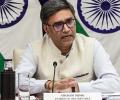
The United States has approved the extradition of Tahawwur Rana, accused of involvement in the 2008 Mumbai terror attacks, to India. The decision was announced by President Donald Trump during a joint press conference with Prime Minister Narendra Modi in the White House. India is currently working on the logistics of Rana's surrender and extradition, with several final steps to be completed before he is sent back to India. The joint statement issued by India and the US during Prime Minister Modi's visit reaffirmed their commitment to fighting terrorism and eliminating terrorist safe havens. The leaders also called on Pakistan to bring to justice the perpetrators of the 26/11 Mumbai and Pathankot attacks. Rana, a Canadian national of Pakistani origin, is currently lodged at a metropolitan detention center in Los Angeles. He is associated with Pakistani-American terrorist David Coleman Headley, one of the main conspirators of the 26/11 attacks.

India has lodged a strong protest with Pakistan over recent objectionable remarks made against Bhagat Singh, the government said in Lok Sabha. The Minister of State for External Affairs, Kirti Vardhan Singh, stated that India has been raising concerns about attacks on cultural heritage, growing intolerance, and lack of respect for minority communities in Pakistan. Singh also highlighted the strong ties between India and Bangladesh, emphasizing that their relationship is independent of Bangladesh's relations with other countries. The government closely monitors developments impacting India's national interests and takes necessary measures to protect them. Singh also provided information about the deportation of Indian nationals from the US, citing data from the US government.

Prime Minister Narendra Modi and Chinese President Xi Jinping will hold bilateral talks on Wednesday on the margins of the Brazil, Russia, India, China, South Africa (BRICS) summit in Russia, in their first structured meeting since the eastern Ladakh border row erupted in May 2020.

'We need to raise the costs and consequences for Pakistan. It is long overdue. Our initial surgical strike was effective for about six months. Then, the Balakot strike provided a deterrent for perhaps two to three years. But we cannot operate under the assumption that such limited responses will suffice for decades to come.'
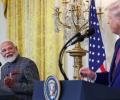
Of Trump's reciprocal tariffs and trade deals

Though he does not know what New Delhi is intending to do, Berlin would "welcome any engagement", he added.

PCB Chairman Mohsin Naqvi has dismissed the possibility of a 'hybrid model', under which India would play at a neutral venue while the rest of the tournament is held in Pakistan.

India has agreed to allow import of pork and pork products from the US as a part of a bilateral trade deal which will facilitate export of Indian mangoes and pomegranate to the US. The development comes months after the two governments renewed the India US Trade Policy Forum (TPF), after which both nations agreed to iron out thorny issues that included market access issues pertaining to the agriculture sector.

India and China on Thursday vowed to redouble efforts to resolve the remaining issues in eastern Ladakh at the earliest and 'stabilise and rebuild' ties even as External Affairs Minister S Jaishankar conveyed to his Chinese counterpart Wang Yi during a meeting that the Line of Actual Control (LAC) must be respected.

In the talks, Putin hoped that Prime Minister Narendra Modi will travel to Russia's Kazan next month to attend the annual BRICS summit.

Reflecting close ties between India and Russia and his personal rapport with Prime Minister Narendra Modi, Russian President Vladimir Putin quipped during their bilateral meeting on Tuesday that they have such a relationship that Modi will not need a translator.

India's External Affairs Minister S Jaishankar has stated that peace and tranquility in border areas are essential for the development of bilateral ties with China. He said India will be discussing de-escalation and effective management of activities in border areas with China in the coming days, following the completion of troop disengagement in eastern Ladakh. Jaishankar emphasized the importance of respecting the Line of Actual Control (LAC), maintaining the status quo, and adhering to past agreements. The disengagement phase allows for discussions on other aspects of bilateral engagement, with national security interests prioritized. However, the statement sparked an uproar in the Rajya Sabha, with Opposition MPs demanding clarifications that were disallowed by the Chair, leading to a walkout.
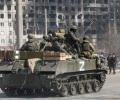
The Indian side is in "very close touch" with interlocutors in the foreign and defence ministries of Russia on the issue of Indians "who were, illegally or otherwise, contracted into fighting in the Russian Army", Misri said at a media briefing on Modi's visit to Russia for the BRICS Summit.
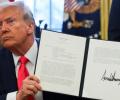
Industry insiders in India warn that any such move in the pharmaceutical sector could be counterproductive for the US as it may face increased drug shortages if tariffs are imposed on such imports.
